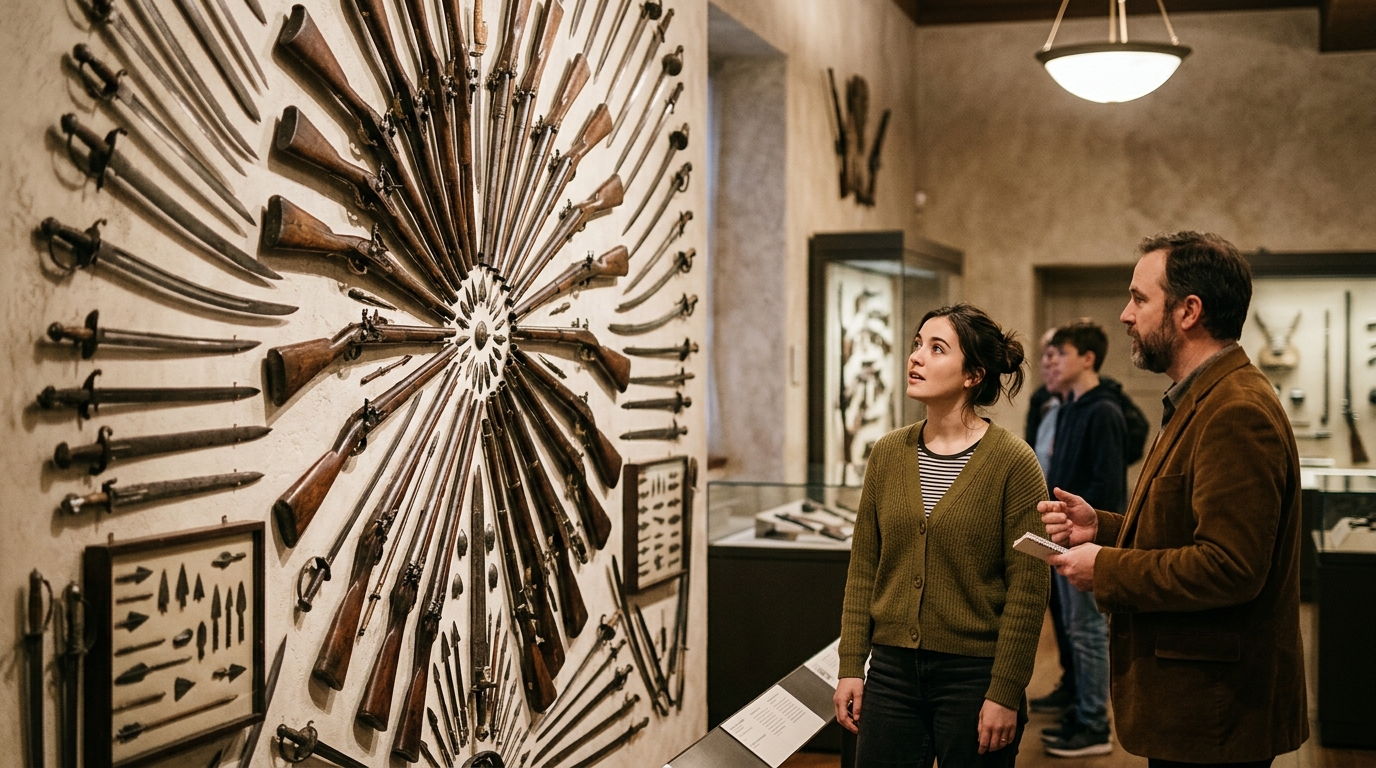
Why Historic Guns, Swords, Arrowheads, and Other Artifacts Were Displayed Like Art
Discover why historic guns, swords, arrowheads, and other artifacts were arranged in wheels, patterns, and wall displays, including the Mason Hotel gun wheels now hanging at the J. M. Davis Museum.
Why Were Historic Objects Displayed Like Art?
When visitors walk through the J. M. Davis Arms and Historical Museum today, they are not just seeing a modern museum display. Some of the wheels hanging inside the museum are the same wheels that once hung in the Mason Hotel, where J. M. Davis first shared his collection with travelers, townspeople, and curious guests.
That detail changes the way you look at them.
They are not only arrangements of historic firearms. They are part of the original Mason Hotel story.
Historic guns, swords, arrowheads, and other artifacts were often displayed artistically because collectors wanted people to notice more than the object itself. A circle, wheel, fan, or repeated pattern helped show craftsmanship, size, variety, and pride. These arrangements turned a wall into a conversation piece.
For J. M. Davis, the gun wheels helped transform the Mason Hotel from a place where people stayed into a place where people stopped, looked, asked questions, and remembered.
That is why these displays still matter. They show us how collectors used design, repetition, and visual impact to make history easier to see.
Why Were They Displayed That Way?
The simple answer is that artistic displays made history visible.
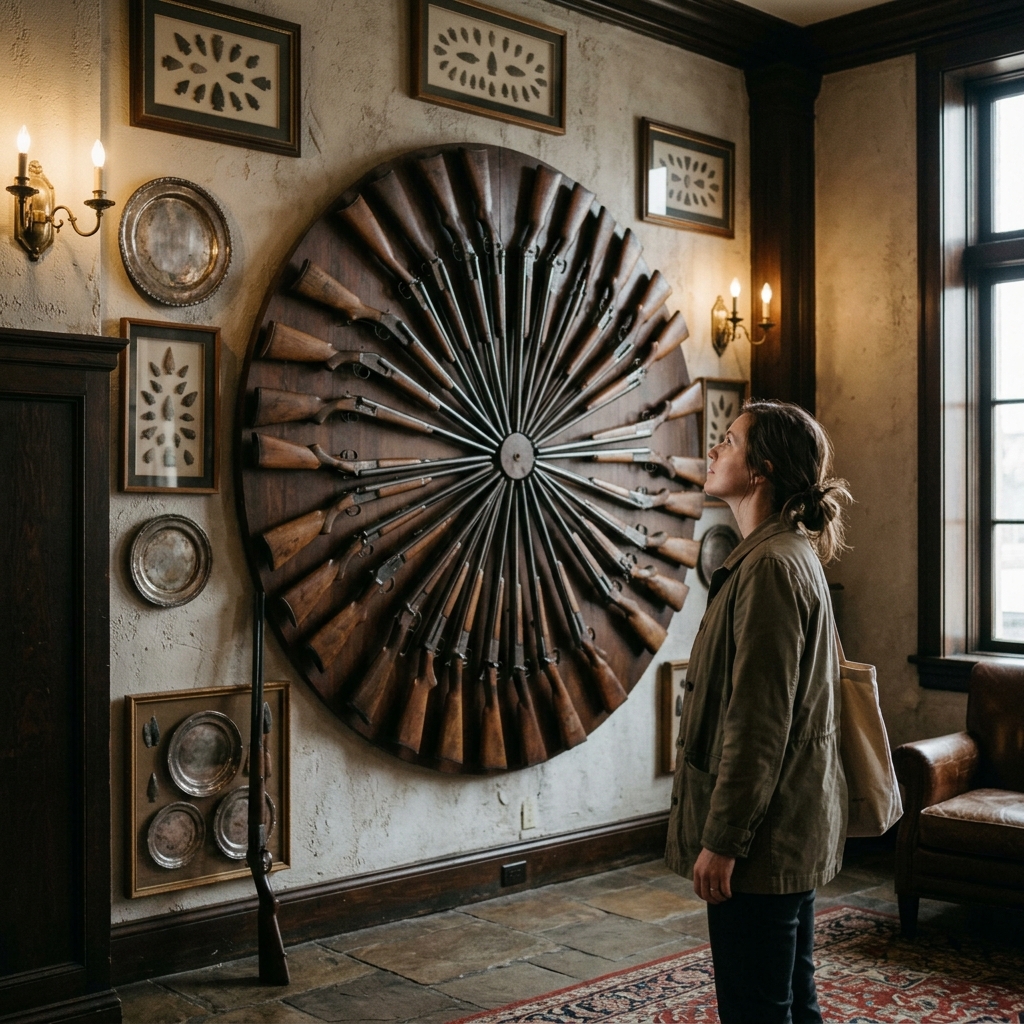
Long before J. M. Davis arranged firearms in the Mason Hotel, people had been using weapons, armor, and rare objects to tell public stories. In ancient and later European traditions, weapons were sometimes arranged as trophies of arms. These displays were used to show victory, strength, rank, memory, and public identity. Over time, the idea of arranging weapons in visually powerful ways moved from battlefields and royal buildings into armories, private collections, and museums.
That is important because it shows that the Mason Hotel gun wheels were not an isolated idea. They were part of a much older habit of turning objects into visual statements.
Historic arms and armor were also valued for craftsmanship. The Metropolitan Museum of Art explains that arms and armor have been important in many cultures for thousands of years, not only for conquest and defense, but also for court pageantry and ceremonial events. The Met also notes that the best armor and weapons represented some of the highest artistic and technical skill of their time.
That helps answer the question of why a collector would display them beautifully. A firearm, sword, or arrowhead could be seen as a tool, but it could also be seen as evidence of design, skill, material, and human effort.
Collections were also arranged to create wonder. In European cabinets of curiosities, also called wonder rooms, rare and unusual objects were gathered together to encourage curiosity and comparison. The Royal Collection Trust describes a Wunderkammer as a “room of wonder” and notes that the idea fully developed in the sixteenth century as European courts became more settled and interested in collecting unusual objects.
That same sense of wonder helps explain the Mason Hotel displays. J. M. Davis was not simply trying to get objects out of storage. The wheels created impact. They showed the size of the collection. They made similar objects easier to compare. They turned craftsmanship into pattern. Most importantly, they gave visitors something unforgettable to talk about.
The Wall Was Part of the Story
Before the J. M. Davis collection became part of a museum, it was part of the Mason Hotel in Claremore, Oklahoma. The museum’s own history notes that the Mason Hotel was built in 1910 and stood at what is now the northwest corner of Will Rogers Boulevard and Lynn Riggs Boulevard, which is also Highway 66. J. M. and Addie Davis came to Claremore in 1916, and Mr. Davis later took over management of the hotel.
The walls of that hotel were not blank background space. They became part of the experience.
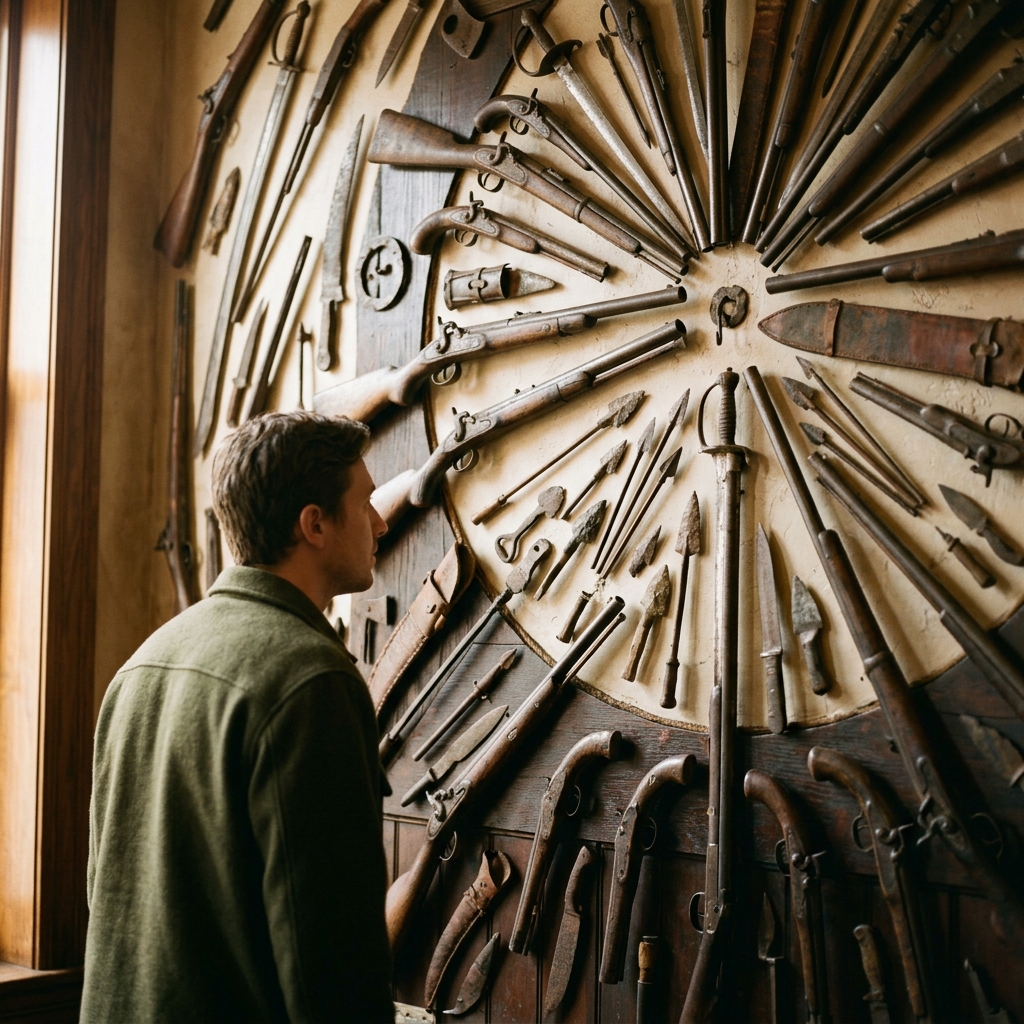
Guests who entered the Mason Hotel were surrounded by objects that immediately caught the eye. Guns, swords, and other pieces were not hidden away where only a few people could study them. They were placed where people could see them, talk about them, and ask about them.
That mattered.
A wall display could do several things at once. It could show the size of the collection. It could create a strong first impression. It could reveal the shape, material, and craftsmanship of each object. It could also help visitors understand that J. M. Davis was not simply storing things. He was building a place of memory.
The Mason Hotel displays also reflected the personality of the collector. Davis clearly wanted people to notice the collection. He wanted people to enjoy it. He wanted the objects to be seen as something worth stopping for.
Today, when those same wheels are seen in the J. M. Davis Museum, they still carry that original purpose. They connect the museum visitor back to the hotel walls where the collection first became part of Claremore’s story.
The Gun Wheel and the Mason Hotel
The gun wheel is one of the strongest examples of how display can change the way people see historic objects.
If the firearms had simply been lined up in rows, visitors might have noticed the number of items. But arranged in a wheel, they become something different. The shape pulls the eye inward. The repetition creates balance. The circle gives the display a sense of movement.
A wheel also makes a large number of objects easier to understand. Instead of seeing one item after another, the viewer sees a design. Then, after the design catches attention, the details begin to stand out.
That is one reason the Mason Hotel gun wheels are so important. They were not just practical ways to hang firearms. They were memorable. They helped turn the collection into something people talked about.
The J. M. Davis Museum history explains that by 1929, after about a dozen years of operating the Mason Hotel, Davis’s collection had grown to 99 guns. In the early 1930s, after acquiring several large collections, the number grew to about 2,500 weapons. As the collection grew, the Mason Hotel became known for it, and the collection eventually became “World Famous.”
That growth helps explain the need for bold display. A small collection can sit in a cabinet. A large collection needs organization, space, and visual order. The wheel helped do that.
It created order without making the display feel dull.
It also gave visitors a way to understand the collection at a glance. They could see the overall pattern first, then move closer to notice the individual pieces.
For J. M. Davis, that style fit the Mason Hotel. The building was already a place where people came and went. The collection gave them something unexpected to remember. Now that the same wheels are hanging in the J. M. Davis Museum, visitors can still see the connection between the original hotel display and the museum today.
Arrowheads, Swords, and the Beauty of Repetition
Firearms were not the only objects that collectors arranged with visual care. Arrowheads, swords, knives, horns, and other historic items were often grouped by shape, size, material, or purpose.
There is a reason repetition works so well in a display.
When arrowheads are arranged together, the viewer begins to notice small differences. One may be longer. Another may be wider. One may be chipped from a darker stone. Another may have a sharper point or a different base. A single arrowhead can be interesting, but a group of arrowheads can show variety, skill, and pattern.
The same is true with swords. When displayed together, they allow visitors to compare handles, blades, guards, length, and style. The viewer begins to see that these objects were not all alike. They came from different times, places, makers, and uses.
The Met’s essay on the decoration of arms and armor explains that weapons and armor across many cultures were decorated to different degrees, and that many societies valued them as signs of rank, status, warrior identity, and diplomacy.
That helps explain why these objects were often arranged with care. Their appearance mattered. Their placement mattered. Their visual relationship to other objects mattered too.
Thomas Gilcrease and other major collectors of Western and Native American history understood that artifacts could be studied and appreciated not only as individual objects, but also as part of a larger visual record. A carefully arranged group helped visitors see relationships between items.
That is what artistic display does well. It helps people compare. It helps them notice. It helps them slow down.
At the J. M. Davis Museum, this matters because the collection is large. Artistic arrangement gives the eye a path to follow. It helps visitors take in the collection without feeling like they are looking at one object after another with no connection between them.
What These Displays Tell Us About Collectors
The way a collector displays objects says something about what the collector values.
J. M. Davis did not keep his collection out of sight. He placed it where people could see it. That tells us something important. He wanted the collection to be shared.
The gun wheels, wall displays, and grouped arrangements show pride in the collection, but they also show an understanding of people. A visitor may not know the history of every object. They may not know the maker, date, or technical details. But they can still recognize pattern, balance, craftsmanship, and scale.
That is where artistic display becomes powerful.
It gives the visitor a way into the story.
A person may first notice the shape of the wheel. Then they may notice the individual firearms. Then they may wonder who made them, where they came from, and why Davis collected them. The display becomes the starting point for curiosity.
This is one reason the Mason Hotel wheels are more than decoration. They show how Davis introduced people to history. He did not wait for visitors to read a long explanation before they became interested. He gave them something to see first.
That is still one of the best ways to help people connect with the past.
Why This Still Matters at the J. M. Davis Museum
The J. M. Davis Arms and Historical Museum is home to one of the most memorable collections in Oklahoma, but the way the collection is displayed is part of the story too.
The museum describes the collection as including more than 12,000 firearms and thousands of other artifacts, including Old West saddles and spurs, John Rogers statuary, Toby mugs, beer steins, World War I posters, and local Claremore and Rogers County history.
That variety matters. It reminds visitors that the museum is not only about one kind of object. It is about collecting, memory, craftsmanship, community, and the many ways people preserve history.
The same wheels that once hung in the Mason Hotel now hanging in the museum give visitors a direct connection to the collection’s early public life. They remind us that this collection did not begin as a quiet museum exhibit. It began as something people encountered in a hotel, in a town, along the path of everyday life.
That is part of what makes the museum special.
The wheels help preserve not only the objects, but also the original spirit of display. They show how J. M. Davis used walls, patterns, and bold arrangements to catch attention and invite conversation.
So the next time you visit the J. M. Davis Museum, look closely at the wheels. Notice the shape before you study the individual pieces. Think about the Mason Hotel. Think about the travelers who may have stopped in their tracks when they first saw the collection on the wall.
Those wheels still do what they were designed to do.
They make people stop, look, and remember.
Related Questions
Why Were Historic Weapons Displayed in Patterns?
Historic weapons were displayed in patterns because the arrangement helped communicate power, craftsmanship, memory, and pride. A pattern also made a large collection easier to understand and more memorable for visitors.
Why Were the Mason Hotel Gun Wheels Displayed in a Circle?
The circle shape created balance, movement, and visual impact. It turned individual firearms into one larger design and helped visitors notice both the whole display and the individual pieces.
Are the Mason Hotel Gun Wheels Still at the J. M. Davis Museum?
Yes. The same wheels that once hung in the Mason Hotel are now hanging inside the J. M. Davis Arms and Historical Museum.
What Is a Trophy of Arms?
A trophy of arms is an artistic or symbolic arrangement of weapons, armor, flags, or military objects. Historically, these displays were often used to show victory, rank, strength, or public memory.
Why Did Collectors Arrange Arrowheads and Swords Together?
Collectors arranged arrowheads, swords, and similar artifacts together so viewers could compare shape, material, craftsmanship, and style. Repetition helped visitors see both variety and pattern.
What Makes the J. M. Davis Museum Collection Unique?
The J. M. Davis Museum is unique because it preserves both a large historic collection and part of the original display tradition from the Mason Hotel. The museum tells the story of the objects, the collector, and the way the collection became part of Claremore history.
Sources
- J. M. Davis Arms And Historical Museum. “About.” J. M. Davis Arms And Historical Museum.
- J. M. Davis Arms And Historical Museum. “J. M. Davis Arms And Historical Museum.”
- The Metropolitan Museum Of Art. “Arms And Armor.” The Met.
- Breiding, Dirk H. “The Decoration Of Arms And Armor.” The Metropolitan Museum Of Art, October 2003.
- Encyclopaedia Britannica. “Trophy.” Britannica.
- Royal Collection Trust. “Wunderkammer: Cabinet Of Curiosities.”
- Gilcrease Museum. “Gilcrease’s Native American Collection.”
- Gilcrease Museum Online Collections. “Arrowhead.”
Share this article
Help someone else find this post
Share it to your favorite platform, email it directly, or copy the link for your next post or message.
Reader reflection
Why do you think the Mason Hotel gun wheels were displayed in such a bold pattern, and what does that display choice tell you about J. M. Davis as a collector?
Think about the difference between storing objects and presenting them. Choose one reason from the article, such as craftsmanship, memory, pride, curiosity, or visual impact. Then write down what you would look for more closely the next time you see the wheels inside the J. M. Davis Museum.
Public reading stays open. Private reflection requires a member account so you can save your thinking and come back to it later.